AP Computer Science Principles Tuition
Seventy multiple-choice questions decide 70% of AP Computer Science Principles; the remaining 30% is two written responses on exam day that refer back to a program the student built and submitted months earlier. We scope that Create task early and build its Personalized Project Reference deliberately, so the exam-day questions have something solid to point at.
Reviewed against the current College Board CED: Written by the TestPrep AP teaching team (since 2008)
AP Computer Science Principles key statistics
AP Computer Science Principles tuition pricing
Prices are shown and charged in Euro — the amount you see is the amount your card is charged. UK, EU and international cards supported.
Single Lesson
- Start with any CS Principles topic you choose
- Full refund if you are not satisfied
- Scheduled around your timetable
10-Lesson Package
- Split the lessons across any AP subjects
- For example: 3 lessons CS Principles + 7 in another AP subject
- Homework with written feedback
AP Computer Science Principles (CSP) is a broad introduction to computing — algorithms, programming abstractions, data, the Internet, and the social impact of computing. The exam combines an end-of-course paper with the Create Performance Task: students submit program code, a video, and a Personalized Project Reference before the exam, then answer two Create-linked written-response questions on exam day alongside the multiple-choice section. We coach both halves of the assessment.
What the AP Computer Science Principles exam looks like
- Format
- End-of-course exam (MCQ plus 2 written-response questions tied to the Create task) + Create Performance Task submitted ahead of time
- Calculator
- Not permitted on the exam
- Language
- Language-agnostic; College Board pseudocode on the exam
- Topics
- Algorithms, abstraction, data, the Internet, programming, computing impact
Exam structure as published in the most recent College Board Course and Exam Description. Always confirm with apstudents.collegeboard.org before exam day.
What AP Computer Science Principles actually tests
AP CSP tests broad computational thinking rather than deep Java fluency. Students must read and trace pseudocode, reason about algorithms and data, and explain the social impact of computing systems.
The Create Performance Task is a real programming artefact: program code plus a video demonstrating execution and a Personalized Project Reference. Two written-response questions on the end-of-course exam then draw on that reference, covering program design, algorithm development, errors and testing, and data abstraction.
Common ways students drop points
- Personalized Project Reference that documents what the code does without explaining the abstraction or the algorithm — this then weakens the exam-day written responses.
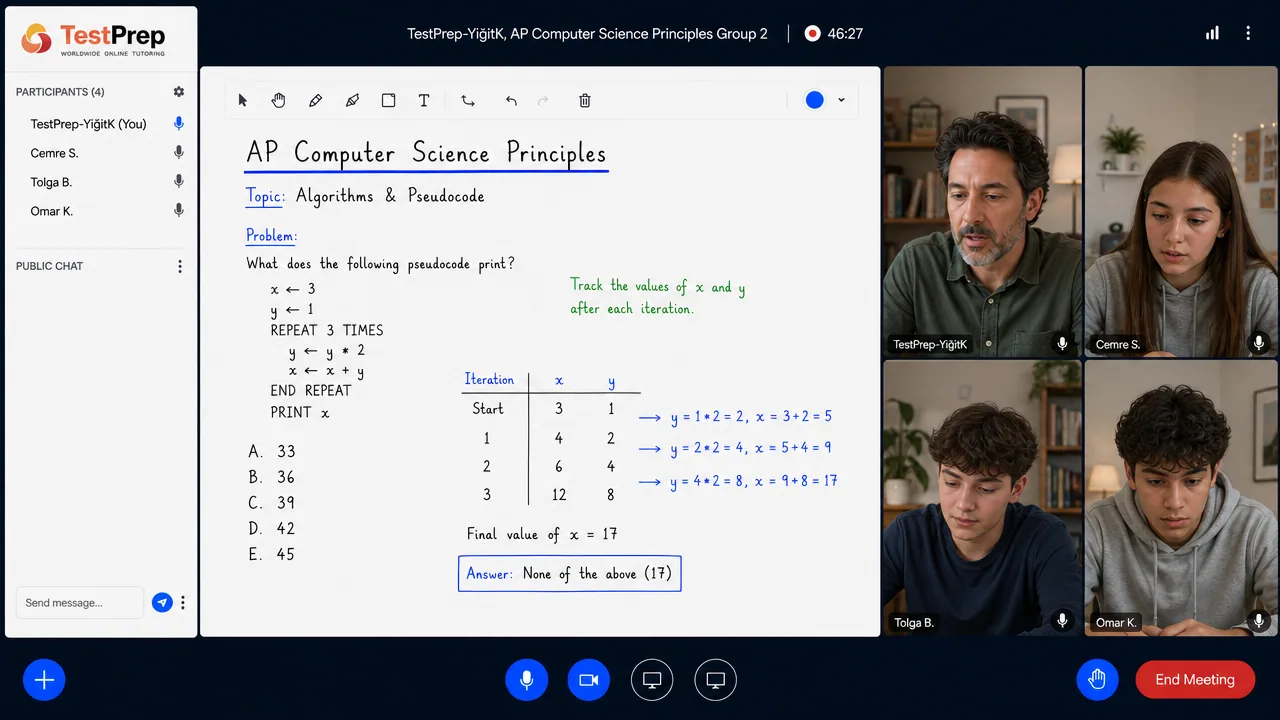
- Pseudocode trace MCQs where the student does not track variable state per iteration.
- Algorithm questions that confuse 'reasonable time' with 'correct' (an algorithm can be correct but unreasonable).
- Data representation questions confusing bit-depth, sample rate, and lossy compression.
- Internet/security questions where end-to-end vs hop-by-hop reasoning is muddled.
How TestPrep tuition closes AP Computer Science Principles gaps
Create Performance Task planning — choosing a program of appropriate scope and building the Personalized Project Reference deliberately.
Exam-day written-response drills against the College Board scoring rubric (program design, algorithm, errors and testing, data abstraction).
Pseudocode tracing practice using released MCQs.
Conceptual block teaching — algorithms, abstraction, Internet, data.
Final-month MCQ mock papers under timed conditions.
How AP Computer Science Principles compares to A Level and IB
AP CSP is broader and less code-heavy than A Level Computer Science. It is comparable in style to the conceptual half of GCSE Computer Science with a US Year 12 layer added. UK applicants to US programmes that are not in CS itself (e.g. business, social science) sometimes present CSP as a computing literacy signal.
Is AP Computer Science Principles the right AP for you?
Students who want a US-recognised computing course without committing to deep Java programming.
Students who already coded a Create-style project at school but need exam practice.
Students aiming at competitive US computer science programmes — AP CSA carries more weight.
AP Computer Science Principles week-by-week study plan
A typical route from first lesson to exam day. We adapt the pace to your start date and target grade — an accelerated version runs the same sequence in fewer weeks.
- Weeks 1–3
Creative Development
The software development process, debugging, iterative development, programming fundamentals.
- Weeks 4–6
Data
Binary, ASCII, Unicode, lossy/lossless compression, metadata, the basics of data analysis.
- Weeks 7–9
Algorithms — Basics
Sequential, conditional and iterative algorithms and statements, functions.
- Weeks 10–12
Algorithms — Advanced
Linear/binary search, sorting, problem decomposition, abstraction, parameter passing.
- Weeks 13–15
Computer Systems and Networks
The internet, TCP/IP, HTTP, DNS, packet switching, fault tolerance, redundancy.
- Weeks 16–18
Impact of Computing
The digital divide, bias, intellectual property, ethics, cybersecurity basics, AI ethics.
- Weeks 19–22
Create Performance Task
Individual project selection, program development, screen recording, the Personalized Project Reference.
- Weeks 23–26
Exam Prep Intensive
AP Classroom Personal Progress Check sets, MCQ strategy, the last three years of exam sets.
Which AP Computer Science Principles preparation model fits you?
Compare 1-to-1 online tuition, small group courses and short-term exam preparation against your target score, schedule and exam date.
1-to-1 Online Tuition
- Best for
- Students who want to progress in AP Computer Science Principles at their own pace, target specific weak topics, or build a plan around their school and AP exam calendar.
- Pacing
- Fully bespoke — 1-to-1 sessions starting from your weakest units.
- Follow-up
- Direct feedback after every session and a targeted homework assignment.
- Flexibility
- Days and times set by the student — flexible online scheduling.
Online Small Group Course
AP Computer Science Principles is taught 1-to-1 only in the 2026–2027 academic year — there is no group course for this subject. Group courses continue to run in other AP subjects.
Short-term Exam Preparation
- Best for
- Students close to the AP exam needing revision, mock papers, FRQ/MCQ strategy and targeted topic repair in AP Computer Science Principles.
- Pacing
- Goal-driven short programme: revision + mocks + weak-topic repair.
- Follow-up
- Mock exam analysis, FRQ/MCQ feedback and exam-day strategy.
- Flexibility
- Plan as 1-to-1 or as a small online group depending on availability.
AP Computer Science Principles tuition — short answers to common questions
Direct answers to the questions students and parents ask most often.
How much does AP Computer Science Principles tuition cost?
AP Computer Science Principles 1-to-1 tuition starts from €58 per lesson, with the per-lesson rate dropping in the 10- and 20-lesson packages. AP Computer Science Principles is taught 1-to-1 only this academic year. See /pricing for current packages and instalment options.
Is AP CSP easier than AP CSA?
It is broader and lighter on code. AP CSA is the heavier programming course. CSP is a better match for students who want general computing rather than a CS major.
When is the Create Performance Task due?
Program code, video, and Personalized Project Reference are submitted to the AP Digital Portfolio before the May exam window — typically by 30 April of the exam year. We plan our CSP programmes around the published deadline so the project is finished with revision time spare.
Can I write the Create Performance Task in Python or JavaScript?
Yes — CSP is language-agnostic. Python and JavaScript are both common choices because they make it easy to demonstrate abstraction and algorithms within the time budget.
Who is AP Computer Science Principles tuition for?
AP Computer Science Principles tuition suits sixth-form and high-school students sitting AP exams worldwide. Whether you are doing A Levels, IB, an American diploma or a national curriculum, our online format works across international time zones.
Is there a group course for AP Computer Science Principles?
No. AP Computer Science Principles is taught 1-to-1 only in the 2026–2027 academic year; there is no group course for this subject. Pace, days and times are set around the individual student. Group courses continue to run in other AP subjects.
How many units are in the AP CS Principles exam?
The AP CS Principles exam follows the College Board CED and is built around 5 core units. Our lessons cover every unit from first principles to exam level, then consolidate with MCQ and FRQ mock papers.
How we support students through AP Computer Science Principles
Six pillars we apply in every 1-to-1 online lesson.
Online 1-to-1 progression
In AP Computer Science Principles 1-to-1 lessons we map every student's strengths and gaps, then update the weekly plan based on what the FRQ practice shows.
Scheduling built around you
AP Computer Science Principles lessons are booked around your own timetable — weekdays, weekends, or concentrated in the run-up to the exam.
AP-format past-paper practice
Regular drills using past AP papers and College Board AP Classroom Personal Progress Checks, in the AP Computer Science Principles format.
Early gap detection
Weekly quizzes and end-of-unit mock papers surface weak AP Computer Science Principles topics early so we can repair them with focused revision.
MCQ and FRQ technique
AP Computer Science Principles multiple-choice and free-response sets are practised against the rubric, with explicit timing and partial-credit strategy.
Parent and student updates
On request, we share progress, mock results and target areas with parents and students together with the AP Computer Science Principles tutor.
Bespoke AP Computer Science Principles tuition built around your goals
Your specialist AP Computer Science Principles tutor works with you 1-to-1 to build a plan around your weakest topics, target score and exam timeline. You get focused individual attention and step-by-step guidance through the AP preparation process.
- Regular weekly slots or on-demand booking
- Native English-speaking tutors available
- Packages of 1, 10 or 20 lessons
- All AP Computer Science Principles materials shared with students
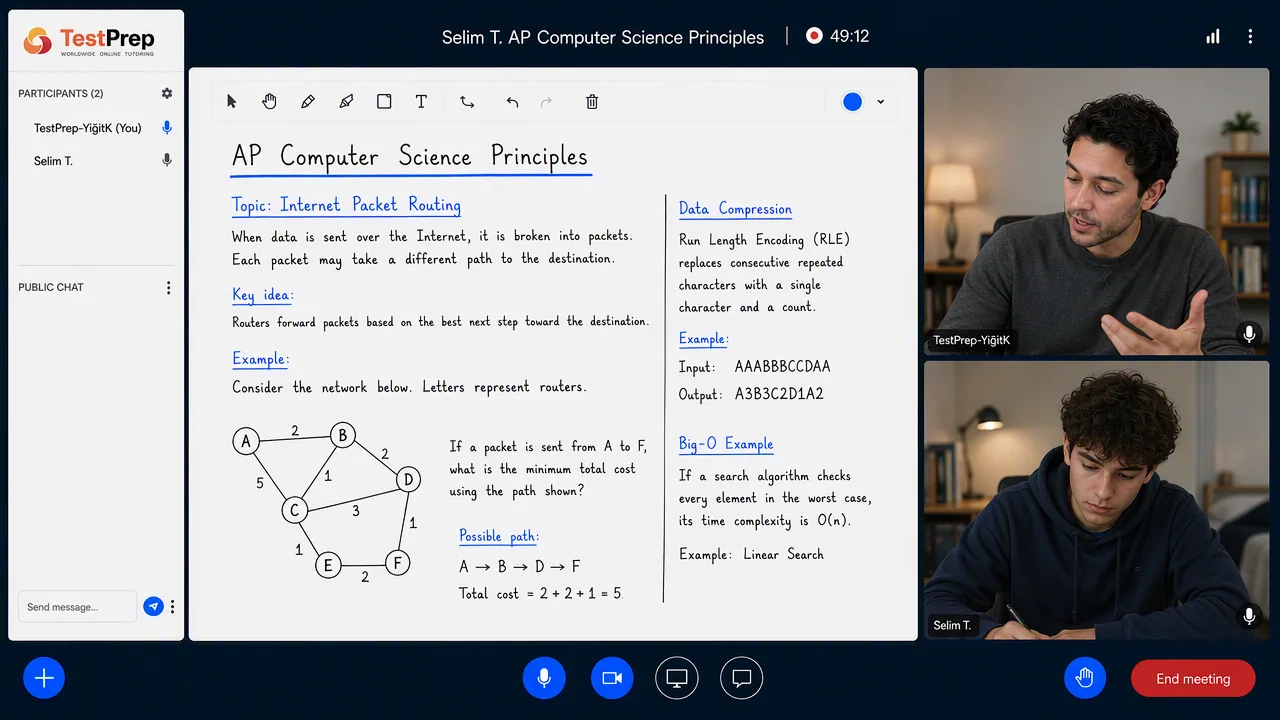
- Live online lessons on a shared digital whiteboard
- 100% refund if you are not satisfied after your first lesson
Quick intro call request for AP Computer Science Principles
Fill in the form and we'll come back with a tailored study plan.
What you'll cover in AP Computer Science Principles
Topic coverage maps directly onto the College Board Course and Exam Description. Each unit is taught with worked examples and reinforced with timed FRQ practice.
The percentage on each unit is its weight on the AP exam. Exam weightings as published by College Board in the Course and Exam Description.
Creative Development
Data
Algorithms and Programming
Computer Systems and Networks
Impact of Computing
AP CS Principles study resources
10 AP AP Computer Science Principles practice tests in College Board format; the AP Computer Science Principles question bank is coming soon.
How to start your AP Computer Science Principles lessons
Choose installment or one-time payment
Complete the short student form sent to you after payment
Your personal student page is created
Access every lesson from your personal page
AP Computer Science Principles lessons built around your weak spots
Catch-up, score lift and exam-window revision — built around AP-style MCQ and FRQ practice.
I am behind — can I catch up?
Yes. We map the AP Computer Science Principles units that matter most for your target score and exam date, then prioritise topic repair over re-teaching everything.
I want a 4 or 5 — how do lessons help?
Lessons focus on AP-style MCQs and FRQs taken from past papers, with rubric-aligned feedback on every written answer.
Will I get feedback on real AP-style work?
Yes. Weekly homework includes timed AP-style sets that your tutor marks against the College Board rubric, with written notes on partial credit.
Can I focus only on my weak units?
Yes. Short revision plans of 10–20 lessons are common, especially in the months before May. We rebuild the plan as the diagnostic reveals new gaps.
Student and Parent Reviews
No comments here yet. Be the first to write one.