
AP US History Tutoring
AP US History begins in 1491 and runs across nine periods, and its document-based question supplies seven primary sources that have to be sourced — author, purpose, audience, context — not merely quoted. Lessons anchor each period to three named events, three named laws and three named people, then practise that sourcing move under the sixty-minute clock.
Reviewed against the current College Board CED: Written by the TestPrep AP teaching team (since 2008)
AP US History key statistics
AP US History tuition pricing
Compare individual lessons, lesson packages and group courses below.
Single Lesson
- Start with any US History topic you choose
- Full refund if you are not satisfied. We do not offer free trial lessons. Payment is required before your first lesson.
- Scheduled around your timetable
- Start with one paid lesson before choosing a package.
10-Lesson Package
- Split the lessons across any AP subjects
- For example: 3 lessons US History + 7 in another AP subject
- Homework with written feedback
Group Course
- Live classes of at most 6, 24 places per group
- Every unit of your subject + 10 AP practice exams
- 2026-27 groups are full; places now for the 2027-28 groups (May 2028 exams)
- Less expensive than the 50-lesson 1:1 package
AP US History (APUSH) covers nine periods from 1491 to the present. The exam is MCQ plus SAQ (Short Answer), DBQ (Document-Based Question), and LEQ (Long Essay Question). We teach APUSH thesis-first: every FRQ rewards a defensible thesis, contextualisation, evidence, and a complexity move.
What the AP US History exam looks like
- Format
- MCQ + SAQ + DBQ + LEQ
- Periods
- Nine periods, 1491–present
- DBQ
- Seven documents to read, analyse, and use as evidence
- Skill
- Thesis, contextualisation, evidence, sourcing, complexity
Exam structure as published in the most recent College Board Course and Exam Description. Always confirm with apstudents.collegeboard.org before exam day.
What AP US History actually tests
APUSH tests whether students can write a defensible thesis, contextualise it in the relevant period, use specific evidence (named events, named legislation, named people), and earn the complexity point by qualifying or extending the argument.
The DBQ requires the additional skill of sourcing — explaining how a document's author, purpose, audience, or historical context affects its argument.
Common ways students drop points
- Thesis statements that re-state the prompt without making a defensible claim.
- DBQ answers that quote documents but never source them.
- LEQs without contextualisation — the situating paragraph before the argument.
- Evidence that is generic ('many laws were passed') rather than specific ('the Indian Removal Act of 1830').
- Complexity points missed because the argument has no qualification or counter-claim.
How TestPrep tuition closes AP US History gaps
Diagnostic on thesis-writing before content.
Period-by-period drill with three named events, three named pieces of legislation, three named people per period.
DBQ sourcing template practised on past papers.
LEQ complexity-move drill — qualification, counter-argument, comparison across periods.
Final-month timed full DBQ and LEQ writing.
How AP US History compares to A Level and IB
APUSH is closer in style to IB History HL (US route) than to A Level History. The DBQ structure is uniquely AP and rewards a specific rubric-driven approach. UK applicants to US programmes in history, political science, international relations, or law commonly present APUSH.
Is AP US History the right AP for you?
Students applying to US history, political science, international relations, or pre-law programmes.
Students with strong content but weak rubric-based thesis writing.
Students with no US context — the nine-period scope is significant.
AP US History week-by-week study plan
A typical route from first lesson to exam day. We adapt the pace to your start date and target grade — an accelerated version runs the same sequence in fewer weeks.
- Weeks 1–3
Period 1–2 (1491–1754)
Native American societies, colonisation, the Atlantic World, the origins of slavery.
- Weeks 4–6
Period 3–4 (1754–1848)
The American Revolution, the Constitution, Jacksonian democracy, the market revolution.
- Weeks 7–9
Period 5–6 (1844–1898)
The Civil War, Reconstruction, the Gilded Age, industrialisation, immigration.
- Weeks 10–12
Period 7 (1890–1945)
The Progressive Era, WWI, the Roaring Twenties, the Great Depression, the New Deal, WWII.
- Weeks 13–15
Period 8–9 (1945–Present)
The Cold War, Civil Rights, Vietnam, Reagan, the post-9/11 era.
- Weeks 16–19
DBQ Mastery
Document analysis (HIPP), thesis writing, integrating outside evidence.
- Weeks 20–22
LEQ & SAQ Practice
Continuity/change, comparison and causation prompts; a bank of specific evidence.
- Weeks 23–28
Exam Prep Intensive
Personal Progress Check sets, full-length mocks, essay revision.
Which AP US History preparation model fits you?
Compare 1-to-1 online tuition, small group courses and short-term exam preparation against your target score, schedule and exam date.
1-to-1 Online Tuition
- Best for
- Students who want to progress in AP US History at their own pace, target specific weak topics, or build a plan around their school and AP exam calendar.
- Pacing
- Fully bespoke — 1-to-1 sessions starting from your weakest units.
- Follow-up
- Direct feedback after every session and a targeted homework assignment.
- Flexibility
- Days and times set by the student — flexible online scheduling.
Online Small Group Course
- Best for
- Students who want to cover the full AP US History curriculum from scratch in a structured small-group format.
- Pacing
- A 30-week structured online programme. Two 90-minute topic lessons a week for 20 weeks, then one past-paper lesson a week for the last 10.
- Follow-up
- Homework, dashboard progress tracking and regular parent reports.
- Flexibility
- Fixed weekly timetable (September–April); every lesson is recorded and watchable for 14 days.
Short-term Exam Preparation
- Best for
- Students close to the AP exam needing revision, mock papers, FRQ/MCQ strategy and targeted topic repair in AP US History.
- Pacing
- Goal-driven short programme: revision + mocks + weak-topic repair.
- Follow-up
- Mock exam analysis, FRQ/MCQ feedback and exam-day strategy.
- Flexibility
- Plan as 1-to-1 or as a small online group depending on availability.
AP US History tuition — short answers to common questions
Direct answers to the questions students and parents ask most often.
How much does AP US History tuition cost?
AP US History 1-to-1 tuition starts from €62 per lesson, with the per-lesson rate dropping in the 10- and 20-lesson packages. The small group course covers the full syllabus (30 weeks / 50 lessons + 10 AP practice exams) for €1,567, the same number of lessons as the 1:1 Full Course Package and costs less than it. See /pricing for current packages and instalment options.
How long is the AP US History exam?
Roughly three hours and fifteen minutes, split between the MCQ section, the SAQs, the DBQ, and the LEQ. Time management on the DBQ is a leading cause of lost marks.
What is the difference between the DBQ and the LEQ?
The DBQ provides seven primary-source documents that must be used as evidence and sourced. The LEQ is a free essay where students bring their own evidence. Both reward the same five rubric points: thesis, contextualisation, evidence, analysis/reasoning, complexity.
Can a UK student do well in APUSH without US background?
Yes. We start with a chronology spine of the nine periods, then layer specific named events and people. The exam rewards rubric-driven writing more than encyclopaedic recall.
Who is AP US History tuition for?
AP US History tuition suits sixth-form and high-school students sitting AP exams worldwide. Whether you are doing A Levels, IB, an American diploma or a national curriculum, our online format works across international time zones.
What is the difference between 1-to-1 tutoring and the small group course?
1-to-1 tutoring is fully bespoke and runs at your pace. The small group course caps at six students, runs to a fixed weekly schedule across an academic year, and covers the full AP US History CED at a lower cost than private tutoring.
How many units are in the AP US History exam?
The AP US History exam follows the College Board CED and is built around 9 core units. Our lessons cover every unit from first principles to exam level, then consolidate with MCQ and FRQ mock papers.
When does the AP US History group course start?
The AP US History group (2026–2027 Term) runs from Saturday, 26 September 2026 to Saturday, 24 April 2027, with 50 lessons on a fixed weekly timetable: 40 topic lessons, then 10 past-paper lessons in which recent AP exams are worked through. Every one of our 2026-27 AP group courses is full — thank you for the interest. The 2027-28 start dates are published on 1 November, and you can enrol now.
How we support students through AP US History
Six pillars we apply across every format — from 1-to-1 online tuition to small group courses.
Online 1-to-1 progression
In AP US History 1-to-1 lessons we map every student's strengths and gaps, then update the weekly plan based on what the FRQ practice shows.
Structured small group courses
In online AP US History classes of at most 6, we cover the full AP curriculum on a fixed timetable: two topic lessons a week for 20 weeks, then one past-paper lesson a week for the last 10.
AP-format past-paper practice
Regular drills using past AP papers and College Board AP Classroom Personal Progress Checks, in the AP US History format.
Early gap detection
Weekly quizzes and end-of-unit mock papers surface weak AP US History topics early so we can repair them with focused revision.
MCQ and FRQ technique
AP US History multiple-choice and free-response sets are practised against the rubric, with explicit timing and partial-credit strategy.
Parent and student updates
On request, we share progress, mock results and target areas with parents and students together with the AP US History tutor.
Bespoke AP US History tuition built around your goals
Your specialist AP US History tutor works with you 1-to-1 to build a plan around your weakest topics, target score and exam timeline. You get focused individual attention and step-by-step guidance through the AP preparation process.
- Regular weekly slots or on-demand booking
- Native English-speaking tutors available
- Packages of 1, 10 or 20 lessons
- All AP US History materials shared with students
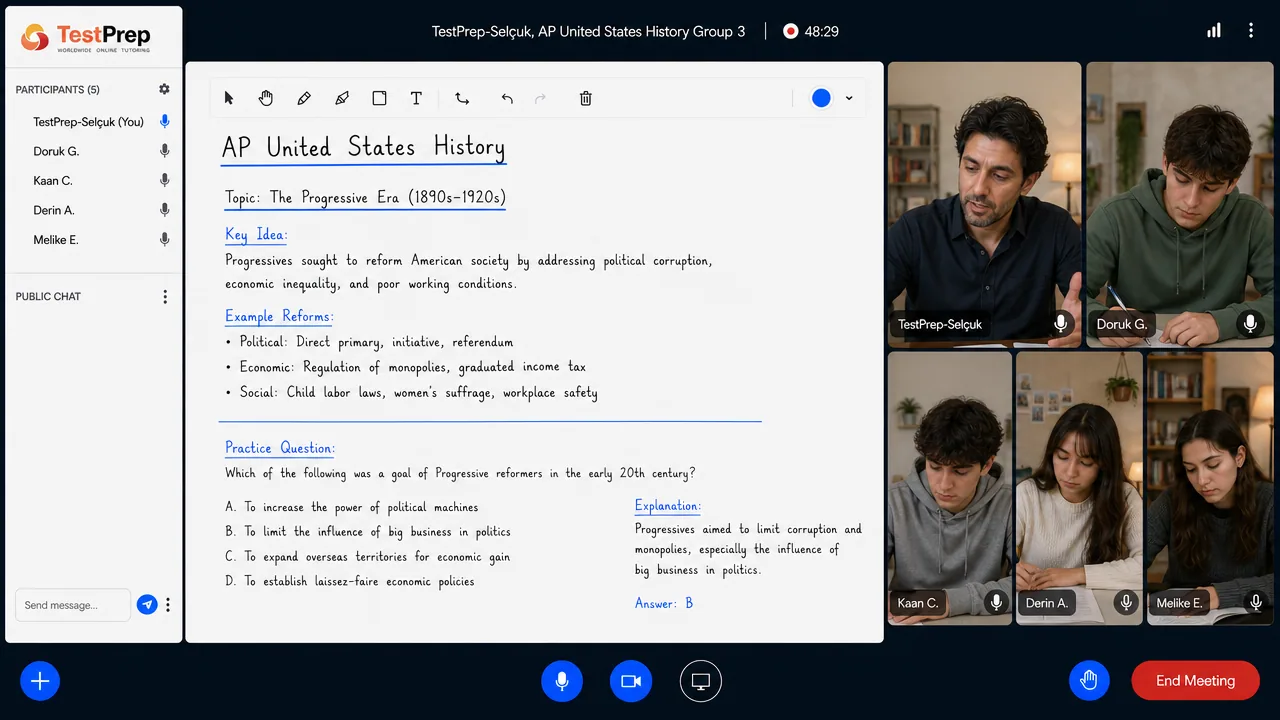
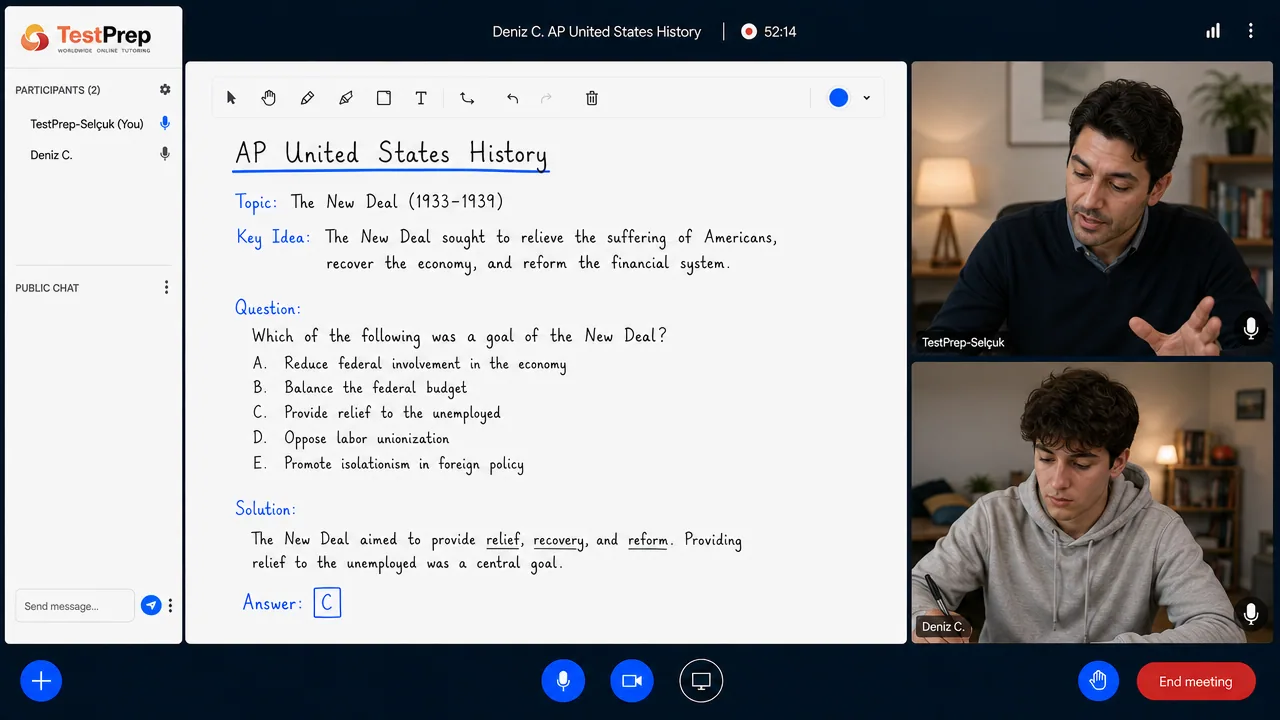
- Live online lessons on a shared digital whiteboard
- 100% refund if you are not satisfied after your first lesson. We do not offer free trial lessons. Payment is required before your first lesson.
Quick intro call request for AP US History
Fill in the form and we'll come back with a tailored study plan.
Affordable 30-week AP US History group preparation
A 30-week live online course with a specialist AP US History tutor: 50 lessons of 90 minutes, 75 hours in total. Two 90-minute topic lessons a week for 20 weeks, then one past-paper lesson a week for the last 10.
Saturdays & Sundays, 10:30–12:00 (Türkiye time, UTC+3) · Classes of at most 6
Our group course takes 24 students, split by level into classes of at most 6.
A group opens when enough students have enrolled. If there are not enough enrolments, you choose what happens to your payment: a full refund, a place in the next group to start, or one-to-one lessons of the same value.
Every one of our 2026-27 AP group courses is full — thank you for the interest. The 2027-28 start dates are published on 1 November, and you can enrol now.
AP groups run subject by subject. Choose your AP subject at checkout; once that subject's 2027-28 dates are published we email you and agree your start date together.
AP US History group course · 2026–2027 Term
The date, time and topic of all 50 live lessons: 40 topic lessons, then 10 past-paper lessons.
| Date | Topic |
|---|---|
| 26 September 2026 | Period 1: 1491-1607 (1/2) |
| 27 September 2026 | Period 1: 1491-1607 (2/2) |
| 3 October 2026 | Period 2: 1607-1754 (1/3) |
| 4 October 2026 | Period 2: 1607-1754 (2/3) |
| 10 October 2026 | Period 2: 1607-1754 (3/3) |
| 11 October 2026 | Period 3: 1754-1800 (1/6) |
| 17 October 2026 | Period 3: 1754-1800 (2/6) |
| 18 October 2026 | Period 3: 1754-1800 (3/6) |
| 24 October 2026 | Period 3: 1754-1800 (4/6) |
| 25 October 2026 | Period 3: 1754-1800 (5/6) |
| 31 October 2026 | Period 3: 1754-1800 (6/6) |
| 1 November 2026 | Period 4: 1800-1848 (1/5) |
Past exams are worked through from 2026 back to 2017. The 2020 exam was a shortened, free-response-only online exam, so a TestPrep practice test takes its place.
There are no lessons in some weeks, so this course runs across 31 calendar weeks. All times are Türkiye time (UTC+3). The timetable may see small updates.
What you'll cover in AP US History
Topic coverage maps directly onto the College Board Course and Exam Description. Each unit is taught with worked examples and reinforced with timed FRQ practice.
The percentage on each unit is its weight on the AP exam. Exam weightings as published by College Board in the Course and Exam Description.
Period 1: 1491–1607
Period 2: 1607–1754
Period 3: 1754–1800
Period 4: 1800–1848
Period 5: 1844–1877
Period 6: 1865–1898
Period 7: 1890–1945
Period 8: 1945–1980
Period 9: 1980–Present
AP US History study resources
10 AP AP US History practice tests in College Board format; the AP US History question bank is coming soon.
How to start your AP US History lessons
Choose installment or one-time payment
Complete the short student form sent to you after payment
Your personal student page is created
Access every lesson from your personal page
AP US History lessons built around your weak spots
Catch-up, score lift and exam-window revision — built around AP-style MCQ and FRQ practice.
I am behind — can I catch up?
Yes. We map the AP US History units that matter most for your target score and exam date, then prioritise topic repair over re-teaching everything.
I want a 4 or 5 — how do lessons help?
Lessons focus on AP-style MCQs and FRQs taken from past papers, with rubric-aligned feedback on every written answer.
Will I get feedback on real AP-style work?
Yes. Weekly homework includes timed AP-style sets that your tutor marks against the College Board rubric, with written notes on partial credit.
Can I focus only on my weak units?
Yes. Short revision plans of 10–20 lessons are common, especially in the months before May. We rebuild the plan as the diagnostic reveals new gaps.
Related AP courses students often consider
AP US Government and Politics
Live online AP US Government and Politics tuition with full CED coverage and weekly FRQ practice.
AP European History
Live online AP European History tuition with full CED coverage and weekly FRQ practice.
AP World History: Modern
Live online AP World History: Modern tuition with full CED coverage and weekly FRQ practice.
Student and Parent Reviews
No comments here yet. Be the first to write one.